
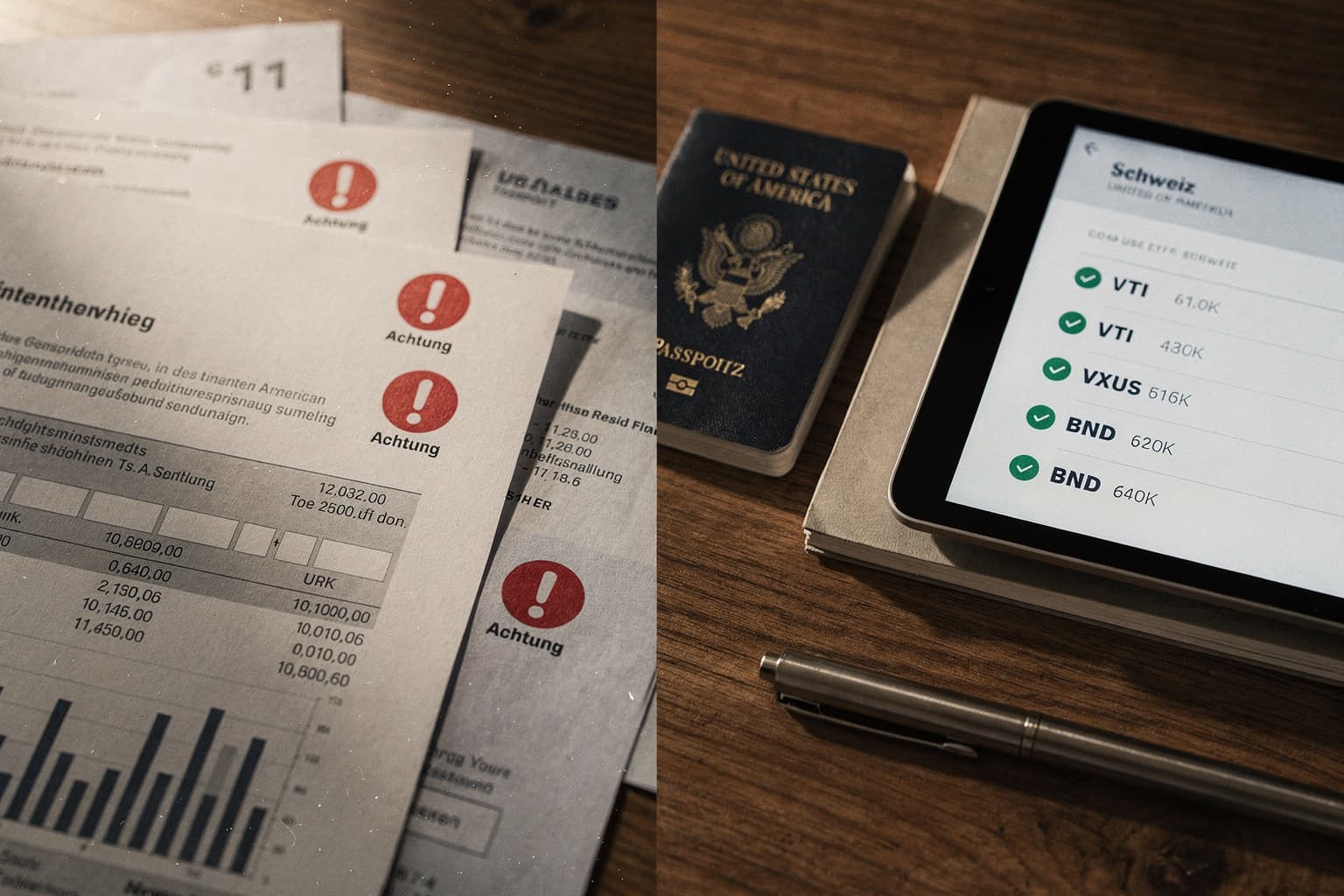
You've built a solid career in Switzerland, you're saving consistently, and your Swiss bank or advisor recommends a diversified portfolio of mutual funds or ETFs. Sounds sensible—except if you're a US citizen or green-card holder, that innocent-looking Swiss fund likely triggers one of the most punitive regimes in the US tax code: PFIC rules. Many Americans in Switzerland discover this trap only after years of holding Swiss funds, facing unexpected five-figure tax bills that wipe out their gains and then some.
This guide walks you through exactly what PFICs are, why Swiss funds qualify, how the IRS taxes them, what Form 8621 requires, and—most importantly—the practical alternatives that let you invest for growth without handing the IRS a blank check.
What Is a PFIC and Why Do Swiss Funds Qualify?
A PFIC—Passive Foreign Investment Company—is any non-US corporation that meets one of two tests: at least 75 percent of its gross income comes from passive sources like dividends, interest or capital gains (the income test), or at least 50 percent of its assets produce passive income (the asset test). The IRS created PFIC rules in 1986 to prevent Americans from deferring tax by parking money in offshore mutual funds that don't distribute earnings annually.
Virtually every mutual fund and ETF organized outside the United States qualifies as a PFIC. That includes Swiss-domiciled funds sold by UBS, Credit Suisse, Swissquote or PostFinance, Luxembourg SICAV funds popular across Europe, Irish-domiciled ETFs from iShares or Vanguard Europe, and most structured investment products. It doesn't matter what the fund invests in—a Switzerland-domiciled ETF tracking the S&P 500 is still a PFIC because the fund itself is a foreign corporation earning passive income.
Domicile Determines PFIC Status
The fund's legal home matters, not what it holds. A Swiss ETF tracking US technology stocks is a PFIC; a US ETF tracking Swiss stocks is not. Always check the fund prospectus for the country of incorporation before you invest.
Swiss banks and wealth managers often recommend local funds for convenience, custody simplicity, or because they earn higher fees. Many don't proactively warn American clients about PFIC consequences—some aren't aware themselves, others assume you'll handle US taxes separately. Either way, the compliance burden and tax penalty land entirely on you.
How the IRS Taxes PFICs: The Default Excess Distribution Regime
If you own a PFIC and don't make a special election, the IRS applies the excess distribution method. This regime is deliberately harsh: it treats any distribution from the fund—or any gain when you sell—as if you earned it ratably over every year you held the investment, then taxes each slice at your highest ordinary income rate for that year and adds a compounding interest charge to simulate the tax you deferred.
Concretely: you buy a Swiss mutual fund in 2018 for ten thousand dollars and sell it in 2025 for eighteen thousand dollars. Your eight thousand dollar gain gets divided across seven years. Each year's slice is taxed at your top marginal rate—potentially 37 percent federal, plus state tax if applicable—and the IRS adds interest at the statutory underpayment rate (roughly three to eight percent annually depending on the year) compounded from the theoretical due date of each year's tax.
37%
Maximum federal ordinary income rate applied to PFIC gains, eliminating long-term capital gains treatment
The result: your effective tax rate on PFIC gains routinely exceeds 50 percent when you include interest charges, and in extreme cases the total tax bill can surpass the nominal gain. There's no long-term capital gains rate, no qualified dividend treatment, no tax-loss harvesting against other investments. Even worse, the calculation is opaque—most tax software can't handle it automatically, requiring manual Form 8621 preparation that adds accounting fees.
QEF and Mark-to-Market Elections: Alternatives That Rarely Work for Swiss Funds
The IRS offers two escape hatches from the excess distribution method: the Qualified Electing Fund election and the mark-to-market election. Both require annual reporting and have strict conditions that most Swiss funds don't meet.
Qualified Electing Fund Election
A QEF election lets you report your pro-rata share of the fund's earnings each year—ordinary income and capital gains—whether or not the fund actually distributes anything. This preserves long-term capital gains treatment and avoids the interest charge. The catch: the fund must provide you an annual PFIC Annual Information Statement showing its earnings under US tax rules. Almost no Swiss, Luxembourg, or Irish funds prepare this statement—it requires tracking income and gains according to US GAAP or tax principles, an expensive and complex exercise with no benefit to the fund sponsor.
Without the statement, you can't make a valid QEF election. Some advisors suggest requesting the information from the fund—worth trying, but expect a polite refusal or silence. A few large fund families (primarily Canadian) do provide QEF statements; Swiss retail funds generally don't.
Mark-to-Market Election
Mark-to-market lets you report the annual change in the fund's fair market value as ordinary income or loss, capping your loss deduction at prior years' mark-to-market gains. This eliminates the interest charge and simplifies reporting compared to excess distribution, but you still pay ordinary income rates and recognize paper gains every December 31 even if you haven't sold.
Mark-to-market is available only for marketable stock—PFIC shares traded on a qualified exchange or readily tradable on an established securities market. Most Swiss mutual funds are open-end funds with daily pricing but no secondary trading, so they don't qualify. Exchange-traded Swiss ETFs do qualify, making mark-to-market a viable election for those positions if you're willing to recognize annual gains.
Elections Must Be Made Timely
Both QEF and mark-to-market elections must be made on a timely filed original return for the first year you own the PFIC or the first year you choose the election. Late elections require IRS consent via private letter ruling—an expensive and uncertain process. Don't wait until sale year to decide.
Form 8621: Annual Reporting for Every PFIC Position
Every PFIC you own requires a separate Form 8621 filing each year, even if you simply hold the position without selling or receiving distributions. The form reports basic information—fund name, country of organization, your ownership percentage—plus details of any distributions, sales, elections or income under QEF or mark-to-market.
The IRS revised Form 8621 in December 2025. The updated version added a currency code field for foreign currency transactions and renumbered several lines, but the substantive reporting requirements remain unchanged. You still must file one form per PFIC per year, and the penalties for failing to file can reach ten thousand dollars per form per year if the IRS determines the failure was non-willful, with higher penalties for willful violations.
Practically, if you hold five Swiss mutual funds for three years without realizing the PFIC issue, you owe fifteen Form 8621 filings when you discover the problem. Preparing these forms—especially excess distribution calculations—usually requires a specialized CPA familiar with international tax, adding hundreds to thousands of dollars in professional fees annually.
Strategic Alternatives: How to Invest Without PFIC Penalties
The single most effective PFIC strategy is avoidance: structure your portfolio using investments that aren't PFICs in the first place. You can achieve full global diversification, low costs, and tax efficiency without ever touching a foreign fund.
US-Domiciled ETFs and Mutual Funds
Funds organized in the United States—typically as US corporations, trusts, or regulated investment companies—are not PFICs regardless of what they invest in. A Vanguard Total Stock Market ETF (VTI) domiciled in the US, a SPDR S&P 500 ETF (SPY), or a Fidelity international equity fund are all free of PFIC taint.
You can buy US-listed ETFs through most Swiss brokers that accept American clients—Interactive Brokers, Swissquote's US trading desk, or specialized expat platforms. Distributions qualify for qualified dividend treatment if applicable, gains held over one year get long-term capital gains rates (zero, 15 or 20 percent depending on income), and reporting is straightforward on Schedule D and Form 1099.
One wrinkle: since 2018, many European brokers restrict sales of US ETFs to retail clients under MiFID II rules unless the fund publishes a Key Information Document for European distribution (most don't). This affects new purchases but not existing holdings, and it doesn't apply if you're classified as a professional client or if you use a US brokerage account.
Individual Stocks
Direct ownership of corporate stock—whether Nestlé, Novartis, Apple, or any publicly traded company—is never a PFIC. Stocks are operating companies, not passive investment funds. You report dividends as qualified or ordinary depending on holding period and the company's US classification, and you report capital gains on sale using the same favorable long-term rates available to US residents.
Building a diversified portfolio of individual stocks requires more positions than buying a single fund, but many expat investors find the tax simplicity worth the effort, especially for core long-term holdings in stable multinational companies.
Direct Real Estate and Operating Businesses
Real property and active business interests fall outside the PFIC definition entirely. Rental real estate in Switzerland, a vacation property, or equity in a business you actively manage won't trigger PFIC rules. Real estate investment trusts and property funds can be PFICs depending on structure, but bricks-and-mortar ownership is clear.
- US-domiciled ETFs and mutual funds – no PFIC, long-term capital gains treatment, qualified dividends
- Individual stocks in operating companies – no PFIC, straightforward Schedule D and dividend reporting
- Direct real estate or active business equity – outside PFIC scope entirely
- Specialized insurance wrappers or private placement life insurance with US tax reporting – complex but potentially compliant structures for high-net-worth situations
What to Do If You Already Own Swiss Funds
Discovering you hold PFICs after several years is common and fixable. The first step is to stop contributions immediately—don't compound the problem. Next, assess your options: sell the positions and reinvest in non-PFIC alternatives, or retain them if the holding period is short and you can make a mark-to-market election going forward.
When you sell, you'll owe the excess distribution tax and interest on the accumulated gain, plus you must file Form 8621 for the sale year and each prior year you held the fund if you haven't already. If you failed to file in previous years, consider participating in IRS relief programs like the Streamlined Filing Compliance Procedures, which allow late PFIC reporting with reduced penalties for non-willful violations.
Document Your Cost Basis Carefully
Swiss banks often don't provide the detailed trade confirmations US tax preparation requires. Before selling PFICs, gather original purchase confirmations, dividend records, and year-end statements to establish your basis and holding period. Missing documentation can lead to the IRS treating your entire sale proceeds as gain.
After liquidating PFICs, rebuild your portfolio using US ETFs or individual stocks. The transition might trigger a one-time tax hit, but you eliminate ongoing Form 8621 filing, the risk of compounding interest charges, and the nagging worry that your investment gains are leaking to excess taxation.
How to Screen Investments Before You Buy
Avoiding PFICs is easier than unwinding them. Before committing money to any fund or structured product, ask three questions: Where is the fund legally organized? What is the fund's structure—corporation, trust, partnership? Does the fund earn primarily passive income?
Check the prospectus or KIID (Key Investor Information Document) for the fund's country of incorporation or domicile. If it's anywhere except the United States, treat it as a PFIC until proven otherwise. Open-end mutual funds, SICAV structures, unit trusts, and most ETFs will be PFICs if foreign-domiciled. Index funds, bond funds, and balanced funds all qualify—the asset class inside doesn't matter.
If your Swiss advisor recommends a fund, ask explicitly: Is this fund organized in Switzerland, Luxembourg, Ireland, or another non-US jurisdiction? If yes, explain that US tax rules make foreign funds prohibitively expensive for you and request US-domiciled alternatives or individual securities instead.
The simplest PFIC strategy is to never buy one. Spend five minutes checking the fund's domicile before you invest, and you'll save years of complex filings and punitive tax bills.
The Bottom Line: Invest Smart, Avoid the Trap
PFIC rules are unforgiving, but they're also entirely avoidable with the right structure. Swiss mutual funds and ETFs may seem convenient when your banker suggests them, but the long-term tax cost far outweighs any short-term simplicity. By building your portfolio with US-domiciled funds, individual stocks, or direct assets, you preserve favorable capital gains treatment, eliminate complex annual filings, and keep more of your returns working for your goals instead of paying compounding interest to the IRS.
You don't need to become a PFIC expert or abandon diversification. You just need to know where the line is and stay on the right side of it. Check the domicile, choose US structures when possible, and consult a cross-border advisor before making large commitments. The peace of mind and tax savings are worth the extra diligence every time.